Work samples

  • Big Ass Snake(plant)s On a Plane, 2025

    Big Ass Snake(plant)s On a Plane, 2025

    1714 N Charles St, Baltimore, MD

    Aluminum, automotive vinyl, and LED programmed lights

  • The Future of Orchids: Conservation and Collaboration

    Video compilation of The Future of Orchids: Conservation and Collaboration, an art activation Howng created for the Smithsonian Garden's 2024 orchid exhibition. Howng created large scaled orchid sculptures, mountainscape sculptures, painted silk tree wraps, and handmade/painted planters installed together to depict the various types of environments where orchids grow, and for forming an imagined future landscape. Layered paintings and sculpturally formed trees that serve as planters, mountain ranges, and rock formations allude to where orchids grow from-the ground (terrestrial), trees (epiphytic), and rocks (lithophytic). The combined sculptural elements help evoke cloud forests, tropical lowlands, craggy cliffs, and temperate meadows that nourish the orchid species that hang from trees, cling to rocks, and blanket the ground. 

  • I'll Be Back-The Yellow Room

    The concepts of Howng’s exhibition I’ll Be Back at Dinner Gallery in 2022, was based on her research into the various causes for the rise in popularity of houseplants during the Victorian Era, and how it still permeates today. Through her sense of humor, Howng imagines how houseplants would have an “awakening” (after the Kate Chopin novel) when realizing they have been displaced from their native habitats, contained, and objectified, only to be neglected by their keepers. The plants then plot to transport themselves back to the past to destroy their first human captors, parodying the Terminator movie franchise. 


    Inspired by Charlotte Perkin Gilman’s short story The Yellow Wallpaper, The Yellow Room was a site specific installation created to reference the Victorian era by remixing the traditional Victorian parlor using Howng’s typical painting language of toxic colored, camouflage-esque patterns.

About Phaan

Phaan Howng (she/her) is a Taiwanese American artist who creates lush, vegetal paintings and installations that examine the various historical perplexities within human-plant relationships, particularly humans' desire to control and tame nature. Her work is informed by paralleling ethnobotanical history and literature, ecological research,, with the sublime of science fiction blockbuster action movies and pop cultural trends. Howng uses camouflage, a modern war tactic, depicted in… more

Big Ass Snake(plant)s On A Plane, 2025

Big Ass Snake(plant)s On A Plane, 2025

Aluminum, automotive vinyl, and LED programmable lights

O.A. 30' h x 40' w x 5' d


This public sculpture combines themes from Howng’s Snakes On A Plain and I’ll Be Back series, and its adjacency to the historic Charles Theater in the Station North Arts and Entertainment District into one. Snakes On A Plain was a theme spurred by my interest to know why people fetishize specific houseplants over others. I focused on the snakeplant because it is mostly known in the U.S. for its practicalities such as “purifying air,” but in other parts of the world, it is seen for its symbolic qualities such as protection, strength and good fortune. It is also linked to Ògún the God of War in Nigerian and Afro-Brazilian religions.  I'll Be Back, explored the origins of house plants and their rise to popularity, especially in the Victorian era and how descriptions of plants in Victorian botanical goth literature was the precursor to how we depict space aliens in sci-fi movies. ‘I’ll Be Back’ had a subnarrative about how houseplants would have an “Awakening” (after the Kate Chopin novel) and try to come back and kill all humans…just like the Terminator movie franchise and Arnold’s infamous catch phrase.  Created for Inviting Light, a Bloomberg Philanthropies x  Baltimore City project curated by Derrick Adams

  • Big Ass Snake(plant)s On a Plane

The Future of Orchids: Conservation and Collaboration, 2024

The Future of Orchids: Conservation and Collaboration, 2024, Kogod Courtyard between Smithsonian American Art Museum and National Portrait Gallery, Washington, D.C.

The Future or Orchids-Conservation and Collaboration was an art activation created by Phaan Howng in collaboration with the Smithsonian Gardens for their 2024 orchid exhibition. Large scale 3D printed orchid sculpture resembling Robert Brendel botanical models, mountainscape sculptures, painted silk tree wraps, and handmade/painted planters installed together to depict the various types of environments where orchids grow, and for forming an imagined future landscape. Layered paintings and sculpturally formed trees that serve as planters, mountain ranges, and rock formations allude to where orchids grow from-the ground (terrestrial), trees (epiphytic), and rocks (lithophytic). The combined sculptural elements help evoke cloud forests, tropical lowlands, craggy cliffs, and temperate meadows that nourish the orchid species that hang from trees, cling to rocks, and blanket the ground. 

  • The Future of Orchids: Conservation and Collaboration (Installation video)

    The Future of Orchids: Conservation and Collaboration (Installation video)

    Compilation of installation images from The Future of Orchids: Conservation and Collaboration.

    The Future or Orchids-Conservation and Collaboration was an art activation created by Phaan Howng in collaboration with the Smithsonian Gardens for their 2024 orchid exhibition. Large scale 3D printed orchid sculpture resembling Robert Brendel botanical models, mountainscape sculptures, painted silk tree wraps, and handmade/painted planters installed together to depict the various types of environments where orchids grow, and for forming an imagined future landscape. Layered paintings and sculpturally formed trees that serve as planters, mountain ranges, and rock formations allude to where orchids grow from-the ground (terrestrial), trees (epiphytic), and rocks (lithophytic). The combined sculptural elements help evoke cloud forests, tropical lowlands, craggy cliffs, and temperate meadows that nourish the orchid species

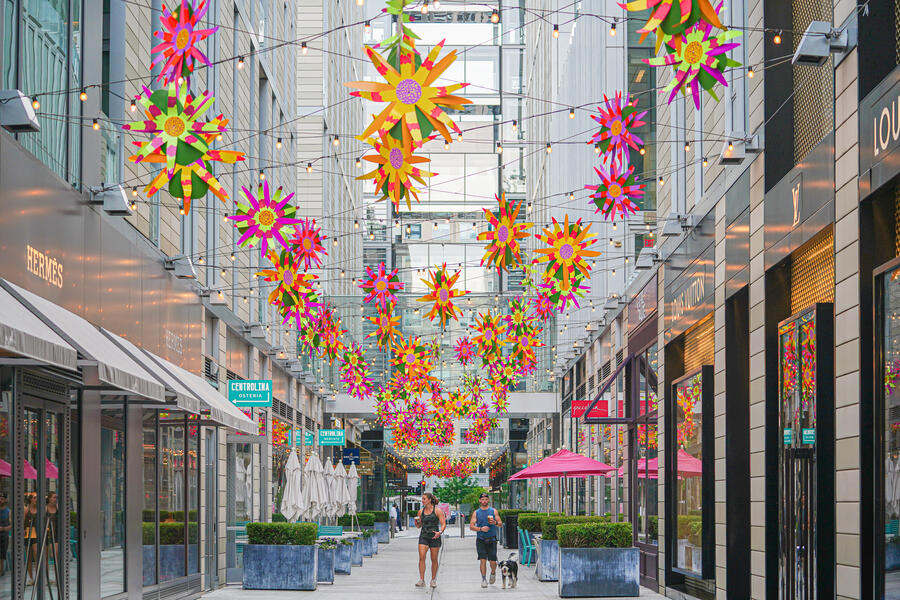
Coneflower Canopy, 2022

  • Coneflower Canopy
    Coneflower Canopy

    Coneflower Canopy, 2022

    CityCentre DC, Washington, D.C.

    Powder coated aluminum, expoxy paint, galvanized aircraft wire

    Plants that inhabit the canopy layer are known as leaders in their plant communities; they maintain diversity, resilience, andbfunctioning. Modeled after this important position and echinacea’s intelligent use of beauty to promote mutual survival, Coneflower Canopy attracts attention by design, seeking to pollinate the mindsof the public. It asks us to consider the responsibility that comes with our privileged place in the local ecosystem and theramifications of the removal of native plants. But however uncomfortable this reflection may be, the coneflowers also offereasy, tangible steps we can all take to be plant allies: to plant more coneflowers and other local flora, and to protect the local native species that are still in their original homes. This piece is outdoors and installed on a seasonal basis every other year. There are a totalof 280 flowers in four different sizes, 48”, 36”, 24” and 18”diameters that are suspended over three city blocks.