-
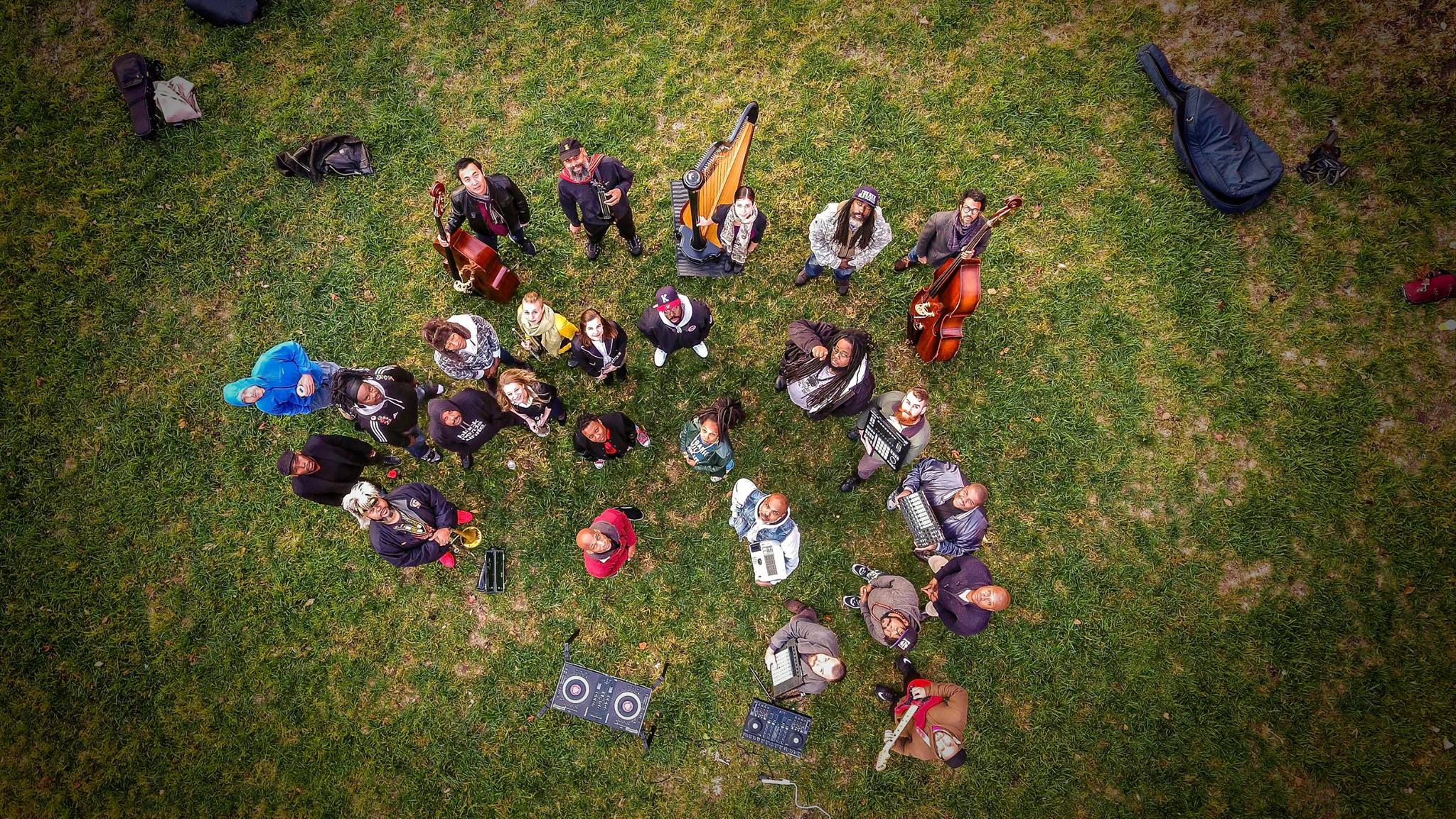
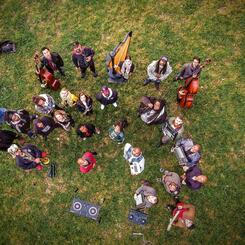
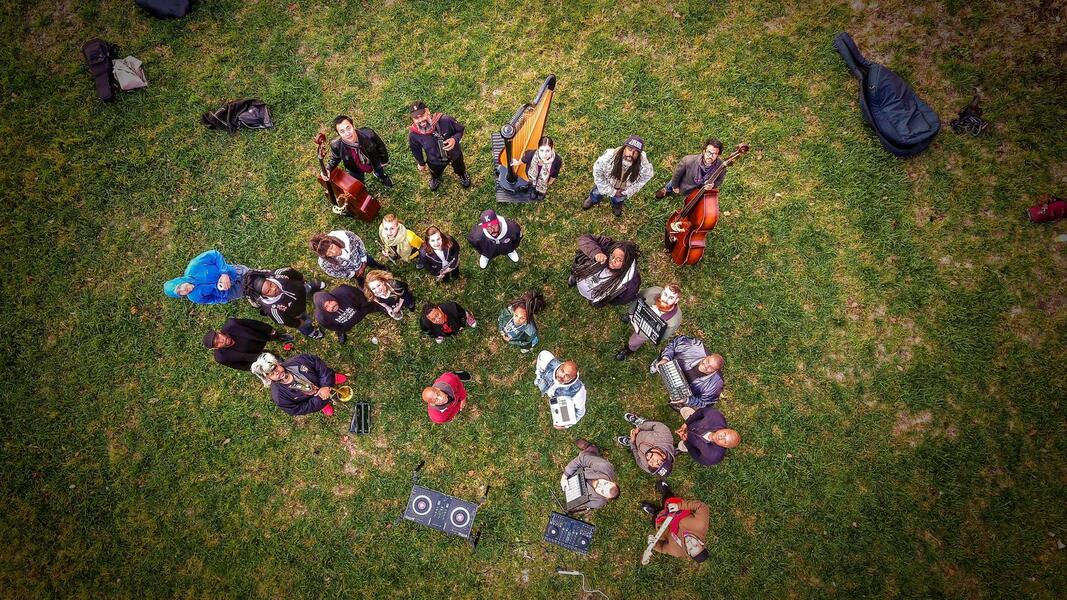 The Baltimore Boom Bap SocietyAn aerial photograph of the Baltimore Boom Bap Society, an improvised hip hop collective. Photograph by Wendel Patrick.
 -
Fratres by Arvo PärtDariusz Skoraczewski, cello; and Jacqueline Pollauf, harp. Fratres was written by Estonian composer Arvo Pärt (b. 1935) in 1977. Pärt is considered a minimalist composer, and the entire piece is based on just a few bars of material. The piece exists in versions for many different combination of instruments. This version is most similar to the version for cello and piano, although the lowest string of the harp is tuned a third lower than usual to approximate the range of the piano.
-
Dance of the Bull by R. Murray SchaferThe Dance of the Bull comes from Canadian composer R. Murray Schafer's (b. 1933) larger suite, the Crown of Ariadne, based on the Greek myth of Thesus, Ariadne and the minotaur. The Dance of the Bull is an aggressive piece depicting the minatour full of fury, with brief moments when the light and airy gestures of Adriadne break through. Many percussive extended techniques are employed, including the xylophone effect, the thunder gliss, the extensive use of pedal slides, and scraping the strings with a coin.
-
In a Landscape by John CageIn a Landscape by John Cage (1912-1992) was written in 1948. He wrote the piece to be played on either solo piano or solo harp. It's a surprising piece as it's not nearly as experimental or avant-garde as one would expect from Cage. Instead, it bears a marked resemblance to Erik Satie's (1866-1925) music, and seems to suspend time.
-
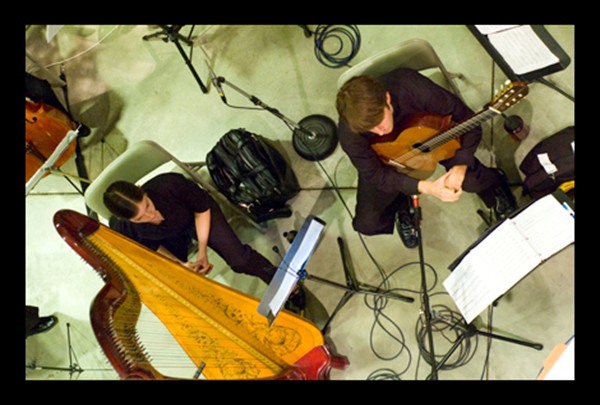
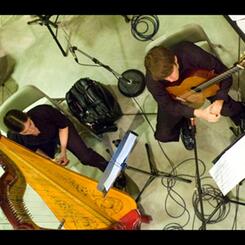
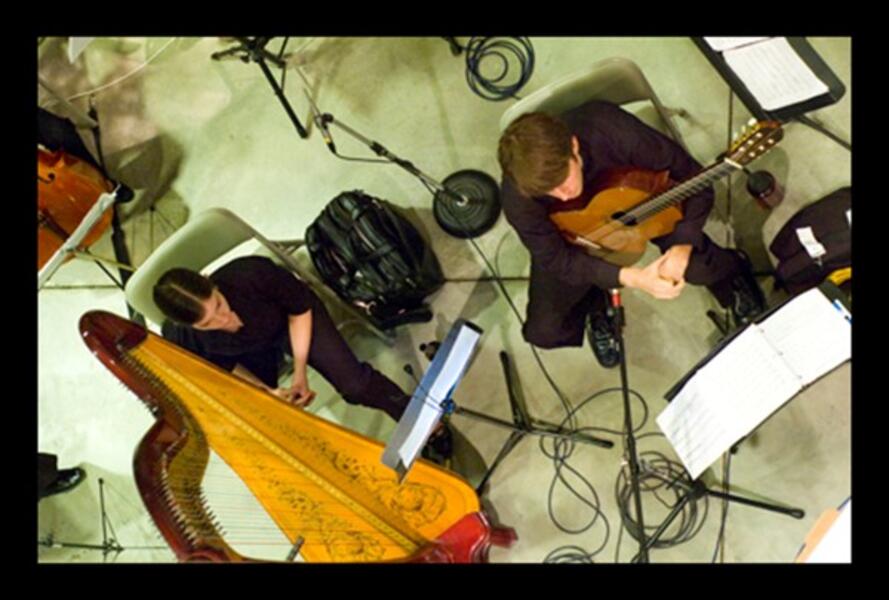 New Music performance at Maryland Institute College of ArtExperimental performance at the Maryland Institute College of Art.
 -
Et Descendit by Sungji HongTrio Sirènes (Marcia Kämper, flute; Karin Brown, viola; and Jacqueline Pollauf, harp) perform Sungji Hong's (b. 1973) work, Et Descendit. Hong composed this work in 2015 and since then Trio Sirènes has championed it, giving it many performances at a variety of venues. The work is a subtle exploration of colors and timbres between the three instruments.
-
Three Shades Without Angles by Hannah LashTrio Sirènes (Marcia McHugh, flute; Karin Brown, viola; and Jacqueline Pollauf, harp) performs Hannah Lash's (b. 1981) Three Shades Without Angles, composed in 2014. The piece alternates between relentless driving sections and quieter spacious sections. Lash's primary instrument is the harp, and she uses the instrument fully, including a section in the middle of the piece where arpeggios start on the lowest string of the harp, climb to the top string and return continuously, making the piece both physically and musically demanding to play.
-
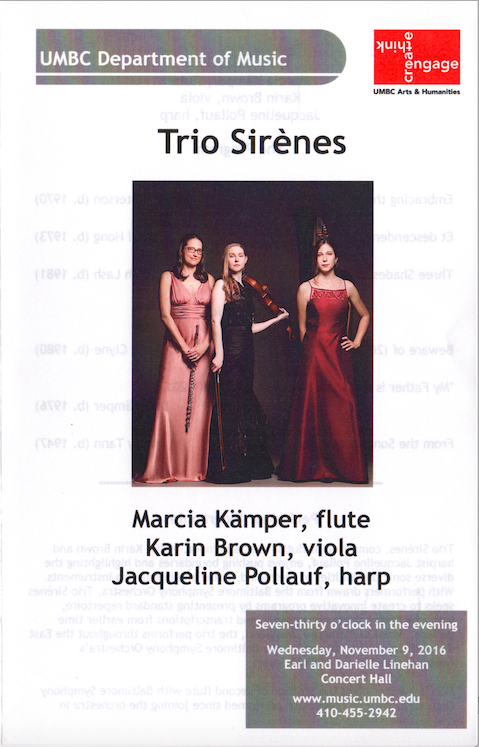
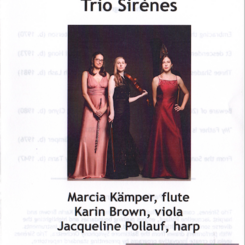
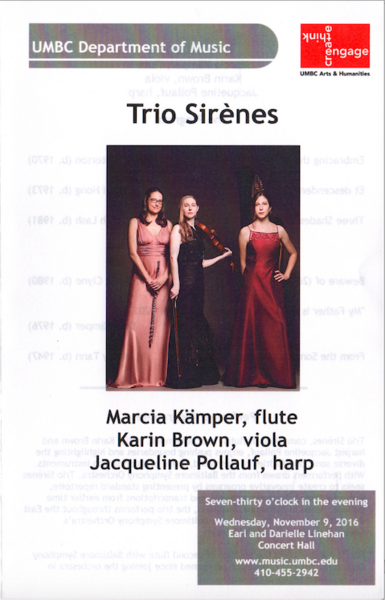 Trio Sirènes contemporary program, cover page, UMBCCover of Trio Sirènes' contemporary program at the University of Maryland, Baltimore County. November 9, 2016.
 -
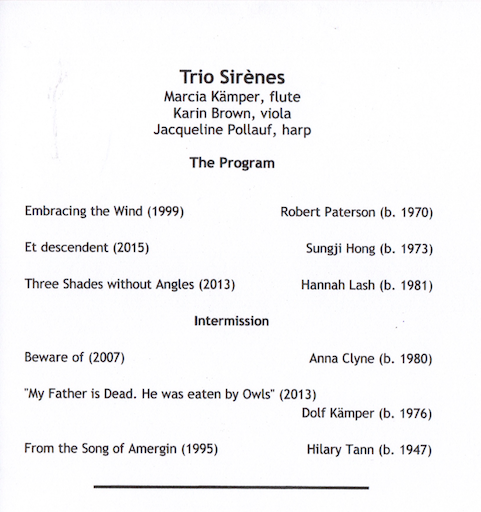
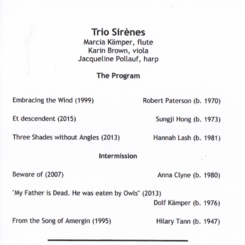
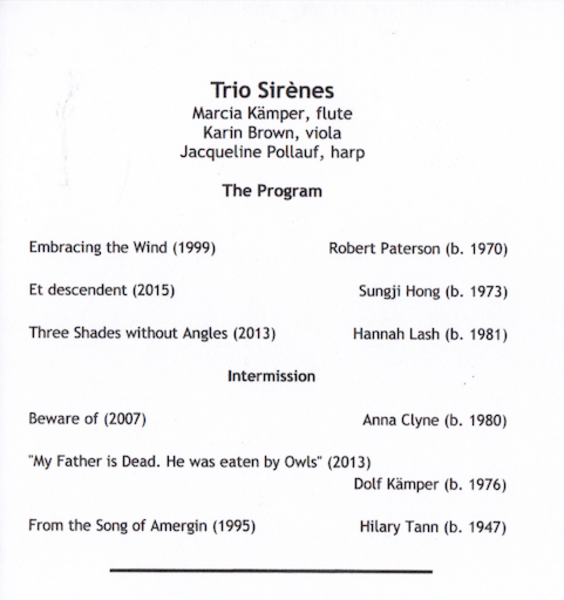 Trio Sirènes contemporary program, inside page, UMBCTrio Sirènes program for a performance of contemporary music at the University of Maryland, Baltimore County, including Et Desendit by Sungji Hong and Three Shades without Angles by Hannah Lash. November 9, 2016.