Work samples
-
Official Trailer for Baltimore Still Rising
“Baltimore Still Rising" is the first intstallment of the Baltimore Legacy Project. This film delves into the heart of Baltimore’s history, amplifying the voices of individuals who experienced one of the city’s most transformative moments. Focusing on the aftermath of Freddie Gray’s tragic death in 2015 following his encounter with the Baltimore City Police, “Baltimore Still Rising” presents intimate interviews with 20 Baltimore residents. These firsthand accounts reveal the raw emotions, deep frustrations, and unwavering resilience that characterized the city’s response to the injustice and ensuing unrest. The documentary transcends a mere recounting of events; it serves as a poignant testament to the ongoing struggle for justice, the enduring spirit of community, and the persistent hope that—despite immense challenges—Baltimore remains a city committed to healing, rebuilding, and rising above its past. Through the personal stories and experiences shared by its residents, “Baltimore
-
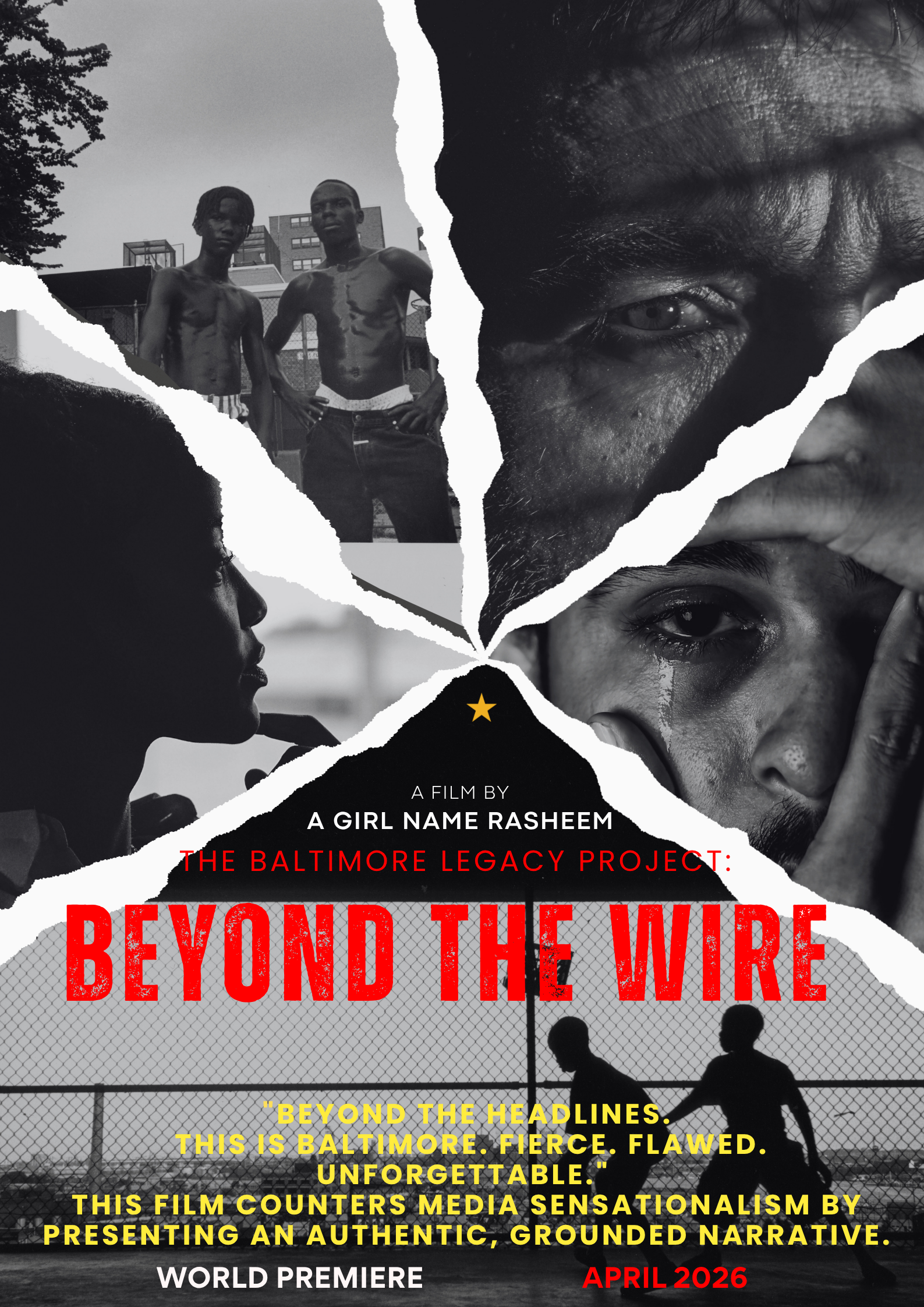
 Beyond the WIRE
Beyond the WIRE is the second installment in the Baltimore Legacy Project.
Mass media and propaganda about Baltimore has dominated mainstream consciousness. Media that sensationalizes drugs, crime and poverty. The goal of “Beyond the WIRE” is to challenge dominant portrayals of Baltimore that center only on crime and poverty by highlighting its long-standing tradition of resistance, community organizing, and grassroots leadership.
Tagline: "Beyond the Headlines. Beyond the Hype. This Is Baltimore. Fierce. Flawed. Unforgettable." Counters media sensationalism by presenting an authentic, grounded narrative.
Beyond the Wire: Film Overview
Beyond the Wire is a powerful counter-narrative documentary that challenges the long-standing media distortion of Baltimore City—particularly the reductive, harmful image popularized by The Wire. Rather than accept depictions of the city as a hub of violence, drugs, and despair, this film uplifts the truths that mainstream narratives ignore: Baltimore’s enduring legacy of resistance, cultural vibrancy, and neighborhood-based resilience.
Drawing on rich interviews with local organizers, educators, historians, and residents, the documentary exposes the systemic failures—disinvestment, miseducation, and over-policing—that have shaped current social conditions. Yet it refuses to portray Baltimoreans as merely victims. Instead, Beyond the Wire centers Black Baltimore’s grassroots leadership, civic engagement, and self-determination. Viewers hear firsthand how generations of residents have fought back—not only against systemic oppression, but against the erasure of their humanity.
The dominance of The Wire as a global cultural reference point is interrogated as not only inaccurate but deeply damaging—flattening Baltimore’s history and silencing the multiplicity of its voices.
Beyond the Wire reclaims the narrative, highlighting the unique character of Baltimore’s neighborhoods, the pride rooted in its public school culture, the creativity that flows through its communities, and the ongoing work to heal and transform. From Sunday stoop scrubbing to back-to-school drives, from policy advocacy to youth-led initiatives, this is the real Baltimore—a city with challenges, yes, but also with undeniable beauty, power, and promise.
________________________________________________________________________________________________________________________________________________________________________________________________________
Full Film Synopsis
Beyond the Wire explores the city far past its infamous reputation, revealing a living, breathing community shaped by history, resilience, and transformation. Baltimore is a City of Neighborhoods, Baltimore’s distinct blocks and corridors each hold unique stories. The narrative traces the Creation of Neighborhoods, examining how geography, migration, and early industry shaped the city’s patchwork identity.
The story then confronts the painful legacy of Divestment from Neighborhoods, detailing how discriminatory policies, redlining, and systemic neglect hollowed out entire communities. This divestment set the stage for the Displacement of Neighborhoods, where urban renewal, highway construction, and rising housing pressures uprooted families and fractured long-standing social bonds.
Against this backdrop, the film interrogates the Depiction of Neighborhoods, contrasting sensationalized media portrayals with the everyday realities of residents whose stories are rarely told. Yet, in the midst of struggle, Baltimore’s spirit shines. Community Coming Together highlights the grassroots movements, local organizers, and faith-based partnerships that refuse to let their neighborhoods fade.
The narrative then turns to the Interfaith Community, showcasing how churches, mosques, synagogues, and spiritual leaders collaborate to support their neighbors, offer sanctuary, and create hope where institutions have failed. Women, too, take center stage in Women in Community, which uncovers the often unseen leadership of mothers, activists, healers, and organizers whose labor sustains the city.
As violence touches many communities, the story focuses on Community Violence Interruption and the rise of Credible Messengers — individuals whose lived experiences give them the trust and authority to mediate conflict and guide young people toward safer paths. These chapters build toward a central question: Who’s responsible for Baltimore’s drop in violent crime? The answer, the story argues, lies not only with policy or policing but with the community’s own boots-on-the-ground efforts.
Finally, in Roses that Grew from Concrete, the film uncovers how today’s violence-interruption organizations were born—rooted in grief, grassroots determination, and the belief that the people closest to the problems are also closest to the solutions. The narrative closes with a powerful reminder: Baltimore’s neighborhoods are not defined by their challenges but by the people who rise each day to remake them.
The "Beyond the Wire" project aims to fundamentally transform how the city is perceived and represented. Its impact includes:
- Challenging Negative Stereotypes: By counteracting sensationalized media portrayals of Baltimore as solely a place of violence, crime, and despair, the project elevates a more nuanced and truthful narrative that highlights resilience, cultural vibrancy, and community strength.
- Centering Local Voices: The documentary amplifies the stories of Baltimore residents, educators, and organizers, empowering Black Baltimoreans to tell their own stories with dignity and depth. This fosters a sense of ownership, pride, and agency within the community.
- Fostering Media Justice: It promotes equitable representation in the media landscape, supporting underrepresented voices and encouraging community-driven storytelling that accurately reflects Baltimore’s diversity and complexity.
- Building Community Pride and Resilience: Through showcasing grassroots efforts like neighborhood initiatives, school pride, and cultural expressions, the film inspires local pride, unity, and continued activism, strengthening civic engagement.
- Catalyzing Cultural and Media Innovation: The project aligns with broader goals of supporting local media makers and creating a new generation of Baltimore-based storytellers, cultivating a vibrant, inclusive media ecosystem that preserves and promotes local culture.
- Contributing to Structural Change: By revealing systemic issues like disinvestment and over-policing while emphasizing community resilience, it advocates for policy change and social healing rooted in local leadership.
Enhancing Baltimore’s Global Image: Ultimately, it repositions Baltimore as a city of complexity and beauty, beyond the stereotypes, fostering a more positive, authentic reputation that benefits residents and attracts diverse engagement.
-
The Counter-Narrative Show
The Counter-Narrative Show
The purpose of the show is to provide a critical examination of society and culture through the intersectional lens of race, gender, and class, more specifically it seeks to provide a COUNTER-NARRATIVE. The Show encourages a reflective assessment and critique of unique standpoints and their potential contribution to popular discourse.
Why this is important?
Although there are a plethora of voices and experiences that make up the fabric of life; most frequently the stories and narratives that are shared, distributed and held up as representative are anything but that. In this, we run the risk of what Chimamanda Ngozi Adachie refers to as “the danger of a single story“.
Holding up a single story, or a single voice as representative of all without taking into account the context of social positioning and identity in the radicalized context that is America is at its very least to tell an incomplete story and at its very worst it leads to the symbolic annihilation of
-
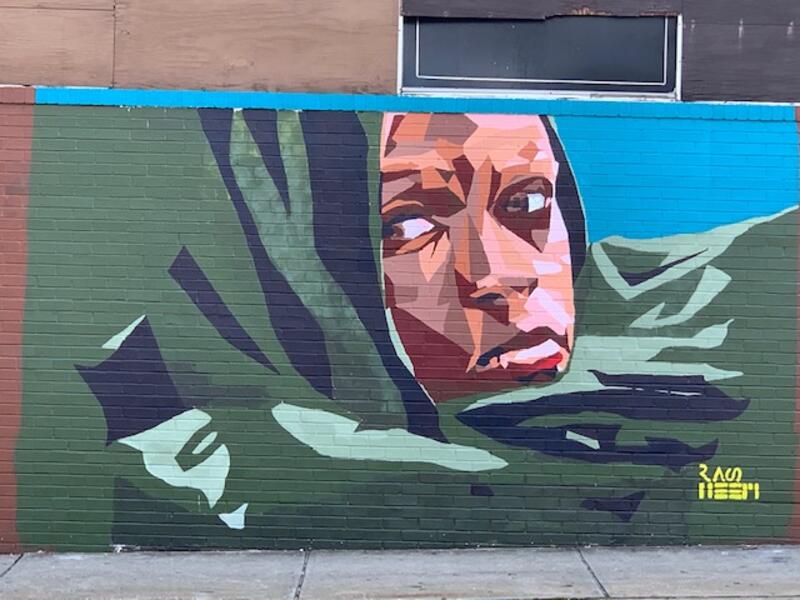 Focus
Focusmural 16 feet long my 10 feet tall.

About Rasheem

s. Rasheem (known simply as Rasheem) is an interdisciplinary Womanist artist, social scientist, filmmaker, and cultural memory worker whose creative practice is rooted in truth-telling, liberation, and the preservation of Black life. As the creator of The Baltimore Legacy Project (BLP)—a multi-part documentary and cultural memory initiative—Rasheem is committed to unearthing, preserving, and amplifying the lived experiences of Black Baltimoreans from 1950–2024. Grounded in the African… more
Queer Religion
-
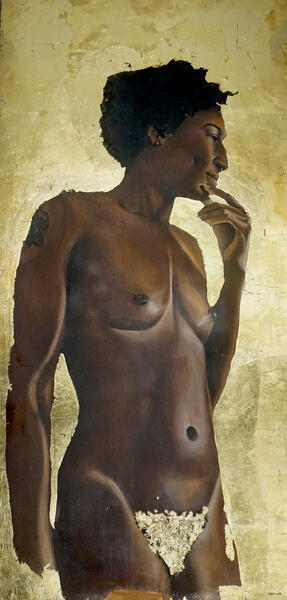 Atom
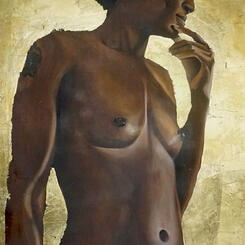
Atomatoms are made up of three particles: protons, neutrons and electrons — which are composed of even smaller particles, such as quarks. Atoms were created after the Big Bang 13.7 billion years ago. ... Quarks came together to form protons and neutrons, and these particles combined into nuclei.
The image is 2feet by 4 feet pan pastel on wood with gold leaf on background and groin.
Available for Purchase -
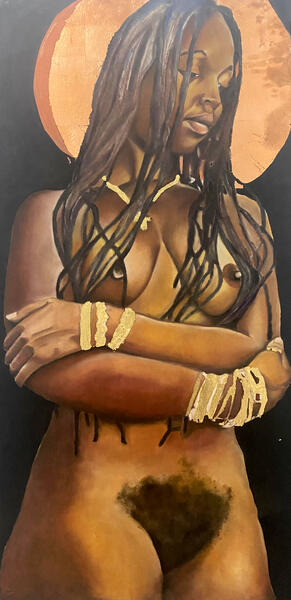 Yve
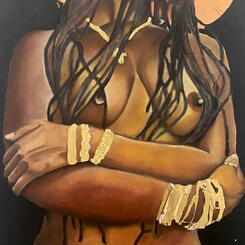
YveEve /iːv/ is an English given name for a female, derived from the Latin name Eva, in turn originating with the Hebrew חַוָּה (Chavah/Havah – chavah, to breathe, and chayah, to live, or to give life). The traditional meaning of Eve is "living". In this iteration she has named herself Yve.
The image mixed media, primarily pan pastel and is 2 feet wide by 4 feet tall on wood.
Available for Purchase -
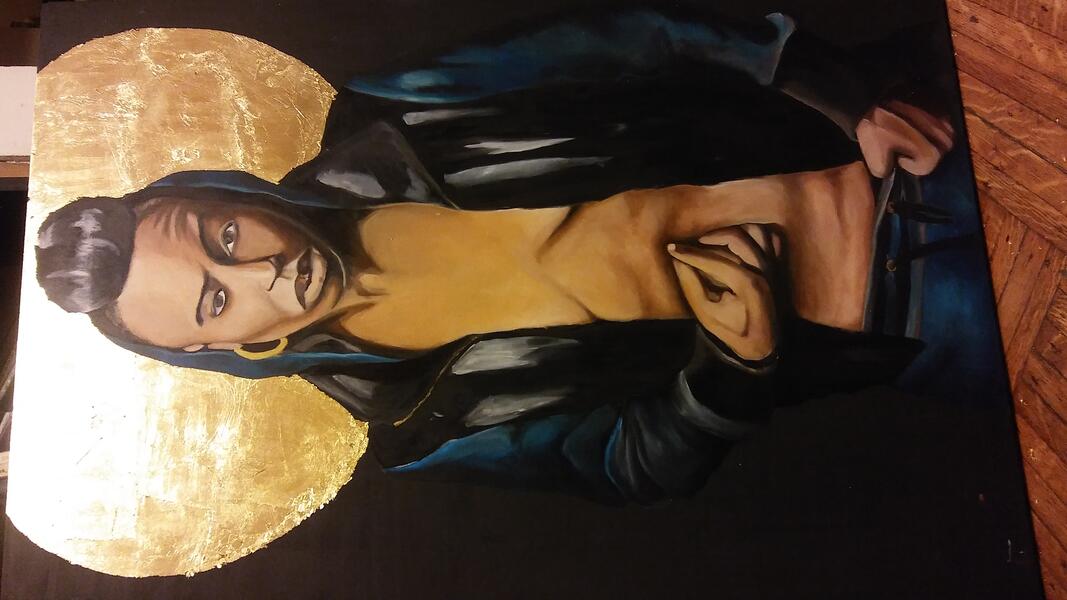 Self Love
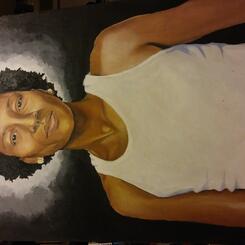
3x4 feet mixed media
Available for Purchase -
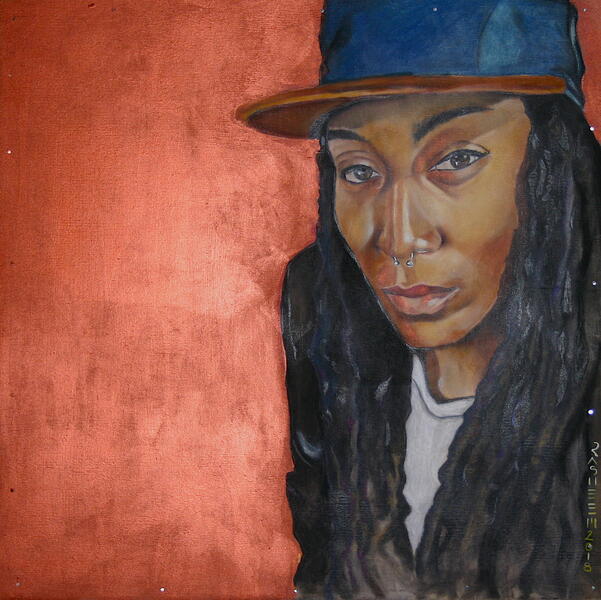 The Lyricist
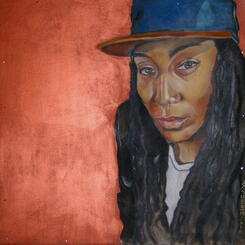
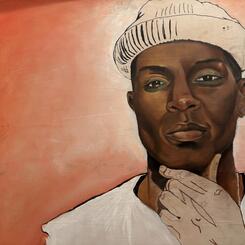
2x2 feet image of a brown-skin person in a blue baseball cap
Available for Purchase -
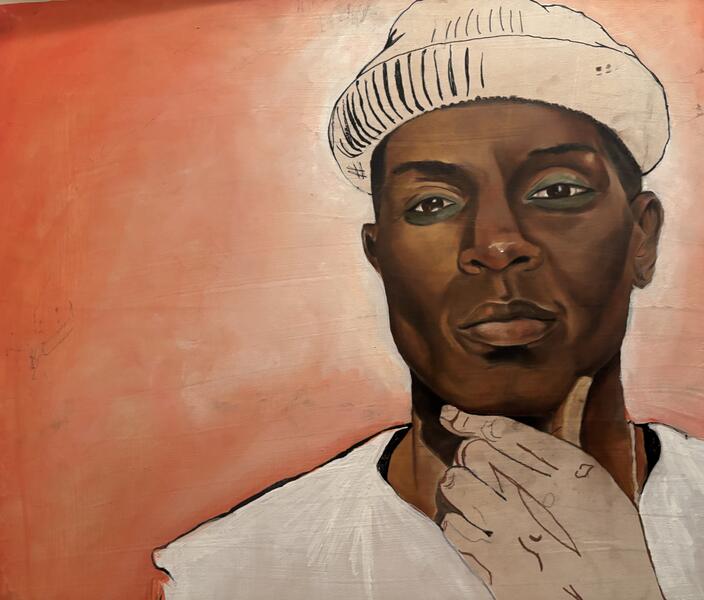 Horus the Meek
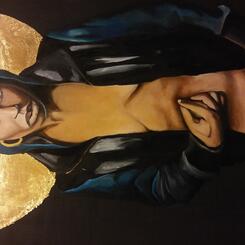
Horus was often the ancient Egyptians' national tutelary deity. He was usually depicted as a falcon-headed man wearing the pschent, or a red and white crown, as a symbol of kingship over the entire kingdom of Egypt. Since Horus was said to be the sky, he was considered to also contain the Sun and Moon. It became said that the Sun was his right eye and the Moon his left, and that they traversed the sky when he, a falcon, flew across it.
the image mixed media, mostly pan pastel and is 3 x3 feet on wood canvas
Available for Purchase -
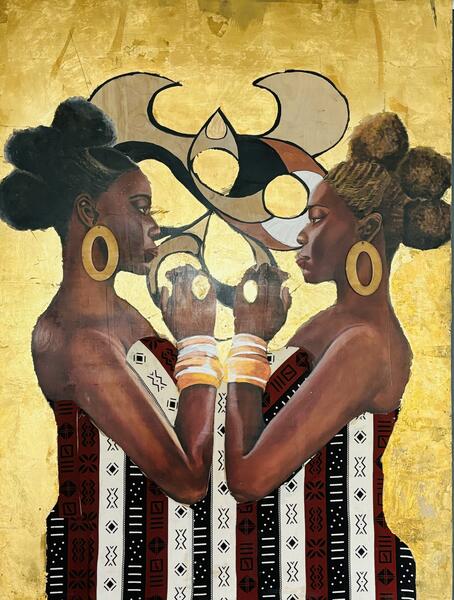 Ibeji
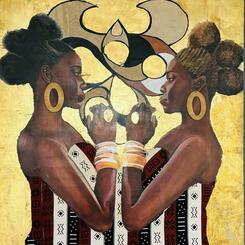
IbejiThe name of an Orisha representing a pair of twins in the Yoruba religion of the Yoruba people (originating from Yorubaland, an area in and around present-day Nigeria).
-
 Oshun
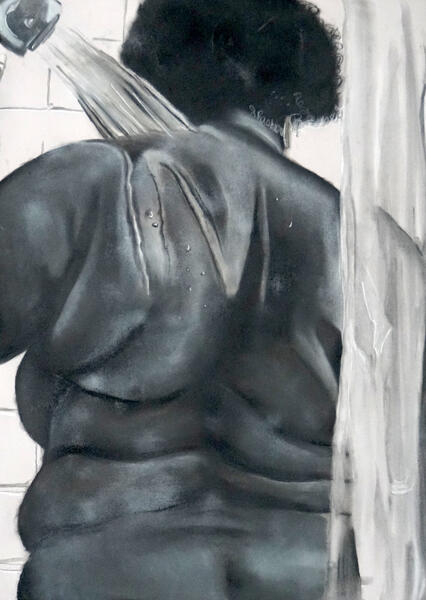
OshunOshun is an important river deity among the Yorùbá people. She is the goddess of divinity, femininity, fertility, beauty and love. She is connected to destiny and divination. During the life of the mortal Osun, she served as queen consort to King Shango of Oyo.
-
 King Cole
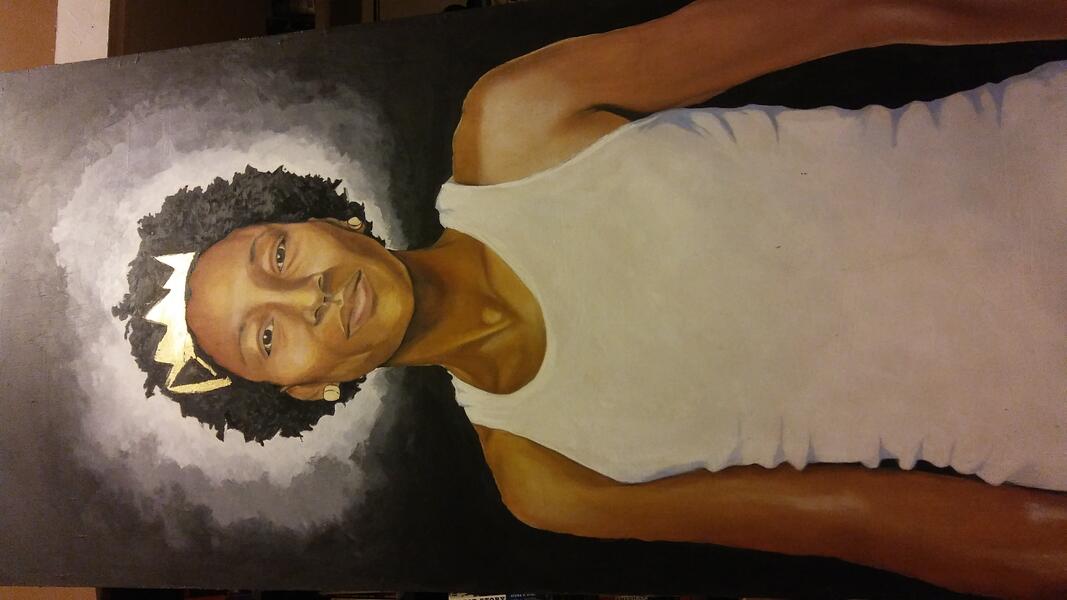
2 feet by 4 feet long on wood canvas, mixed media
Available for Purchase