Work samples
-
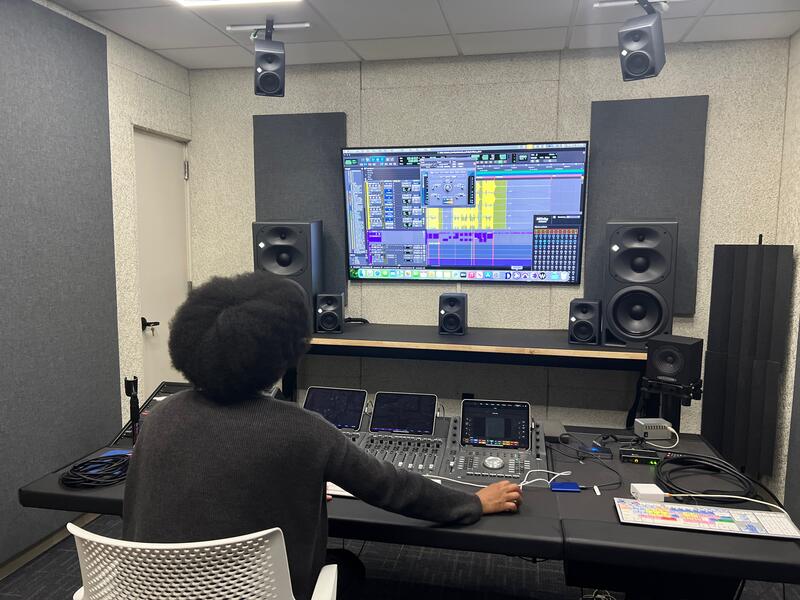 "Lullaby for Ebun" - Sound Design Process
In Lullaby for Ébùn, I reframe postpartum soundscapes as compositional material. After becoming a mother in fall 2024, I recorded breast pumps, toy xylophones, and humidifiers, treating them as sonic architecture. I edited and distributed these sounds throughout a 360-degree sound field alongside instrumental and vocal performance, preserving the physical and emotional contours of my daughter’s nursery. Lullaby for Ébùn will be released in May 2026, accompanied by a 16mm visual filmed by Margaret Rorison.
During an impromptu listening session, I played Lullaby for Ébùn for five friends. They listened from the sweet spot of a 7.1.4 Dolby Atmos speaker array. As sound emerged from behind, around, in front of, and above them, their bodies responded by leaning, shifting, rising onto their toes to follow moments that drew their attention.
After the piece ended, one friend (the only other woman in the room) remained silent. The lyrics, the breast pump, the toy xylophone, the fatigued vocal, and subtle low-frequency emphasis had worked together. Her face flushed. Then she began to speak, recounting memories from her own postpartum experience.
I understand this response as reminiscence: a process through which memory is activated through sensory encounter rather than instruction. In therapeutic contexts, reminiscence is known to support emotional regulation, reduce anxiety and depression, and reinforce a sense of purpose. In this moment, sound did what I designed it to do; it opened a space where memory could surface safely without explanation or the labor of validation.
-
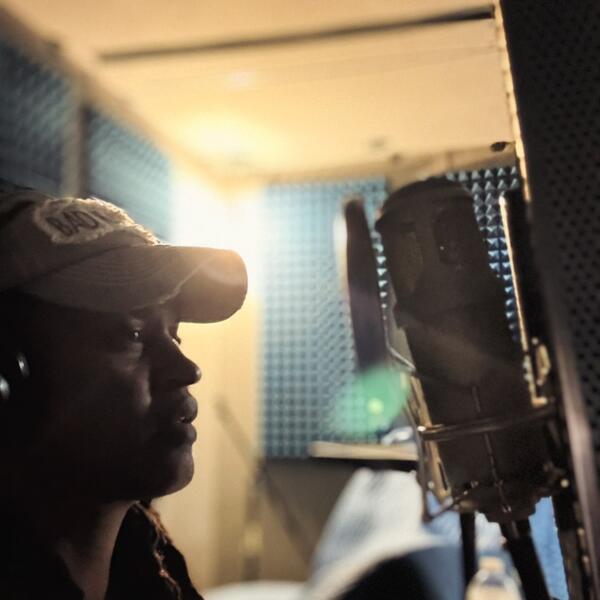 "The Sound of Toxic Stress"
When You Hit Me is a 3D medical application currently in development at the Morgan State University Institute for Urban Research, with a planned release in April 2026. As the project’s sound designer, I record and construct all sonic elements, including narration, effects, and musical composition. Using spatial audio, I shrink the listener’s perceptual scale and place them inside the body of a developing child, allowing sound to convey how stress and trauma reshape the internal world under harsh punishment.
For "The Sound of Toxic Stress", and all sections of the When You Hit me platform, I developed an audio-first narrative environment that leverages Dolby Atmos spatialization, psychoacoustic principles, and dynamic frequency sculpting to sonically render the physiological and emotional impacts of childhood trauma, providing the listener with a 3D experience via the binaural (spatial) or stereo listening format. -
 Counter Narratives
Counter Narratives is a multimodal project consisting of music, an oral history initiative, and a book chapter. Together, these forms respond to dominant media narratives that emerged during the COVID-19 pandemic, particularly those shaping ideas of labor, productivity, and visibility in creative work.
(click bold text to listen or view)
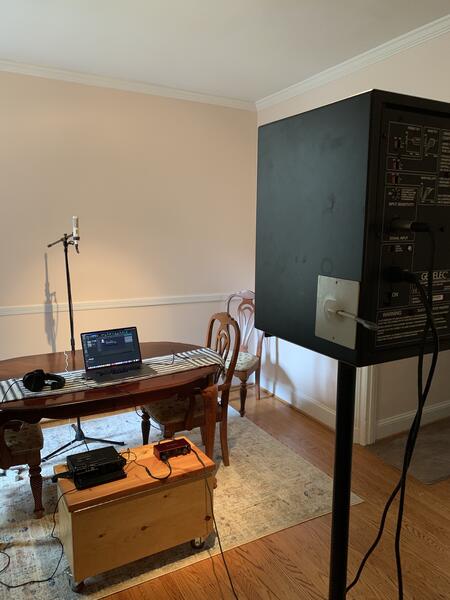
- The Counter Narratives EP is an ode to work-from-home life and the blurred boundaries between labor, domestic space, and self. Its sonic texture draws inspiration from Alvin Lucier’s I Am Sitting in a Room, using repetition and resonance to make the inaudible dimensions of a space perceptible. To render the interior of my home audible, I recorded my voice using contemporary recording tools, played it through the speakers of a vintage Marantz field recorder, re-recorded it, then routed the sound through Genelec monitors—repeating the process until the resonant frequencies of the room imparted themselves onto the voice. As many of us became increasingly merged with our home environments and computer-mediated work, this process (voice passing repeatedly through surface, circuitry, and space) became a meaningful sonic metaphor for that entanglement.
- Counter narratives, as an oral history project, gathered the stories of women audio engineers and producers navigating the pandemic years. I was interested in how my community of peers weathered prolonged isolation, economic instability, and shifting labor conditions, and whether, like many artists, they turned to emerging financial systems such as cryptocurrency as a means of survival and autonomy.
- These inquiries culminated in a book chapter, Modeled Maatic Counter Narrative Theory: Examining the Erasure of African-American Women in Audio to Answer the Music Industry’s Gender Equity Question. In this written form, Counter Narratives becomes theoretical. The chapter proposes a pastiche framework drawing from Tone Theory, Maatic Theory, Social Learning Theory, and an Ubuntu worldview to address the systemic erasure of African-American women from the music industry’s key technical roles. This chapter appears in Black Communication Theory, Volume 2 published by Palgrave Macmillan.
Across sound, story, and theory, Counter Narratives operates as a single inquiry: an insistence on interior knowledge, collective memory, and the right to be heard on one’s own terms. This work received funding support from the Center for Women, Gender, and Global Leadership.
Available for Purchase -
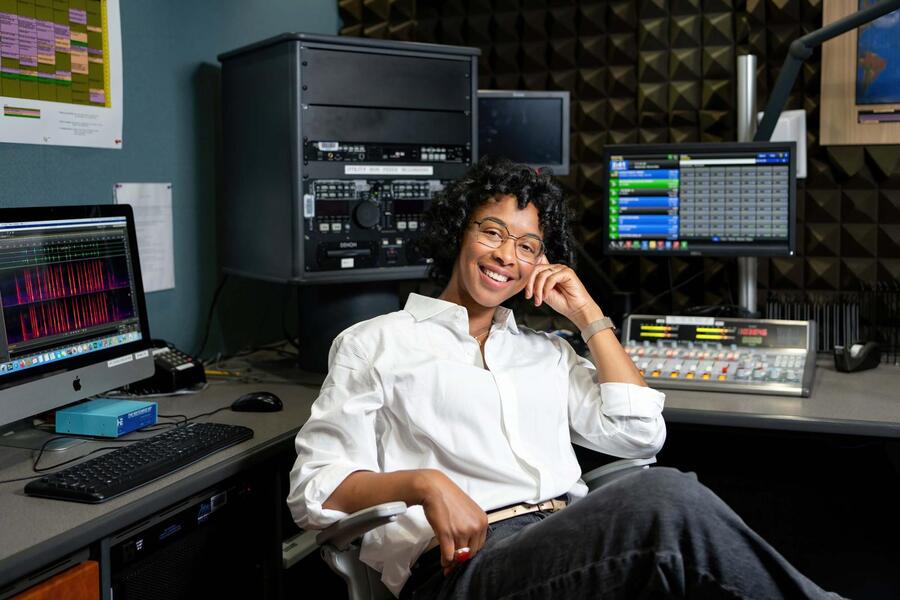 Writing and Theoretical Approaches to Interdisciplinary Sound Design Work
“When Yolanda Adams, John Legend, and I need string arrangements, we call Nicole Neely Hardin. You might not know her name, but Beyoncé does.” - Carolyn Malachi https://magazine.howard.edu/stories/signal-and-storyI treat writing as another listening space to let ideas reverberate before they become sound. While I write for enjoyment, as in "Who Catfished Ella Fitzgerald" which appears in the New York Times (https://www.nytimes.com/2025/06/04/arts/music/ella-fitzgerald-jazz-music.html), writing allows me to test my questions, stretch my methods, and imagine new systems. In a way, writing operates as a parallel studio practice that feeds my sonic work.
Signal and Story gathers this inquiry, tracing sound as cultural archive, ethical encounter, and embodied experience. https://magazine.howard.edu/stories/signal-and-story
Resonance Lab, uses writing to prototype interdisciplinary approaches to immersive listening. This is research, composition, and care wrapped into one, and I will present at the 2026 BEA conference in Las Vegas, NV.
At International Association for the Study of Popular Music in March of 2026, Lullabies for the Diaspora, the album home for Lullaby for Ébùn, extends autobiographical sound into discourse, asking how interior life circulates within popular music and listening culture.
Call & Response: A System for Converting Interactive Data into Money and Sound pushes writing toward systems design. This writing sketches an economy where participation and value respond to one another in real time through re-embodied sound. https://www.emerald.com/books/edited-volume/12596/chapter-abstract/82866008/Call-and-Response-A-System-for-Converting


About Carolyn
"My practice centers internal life. I work in immersive audio (Dolby Atmos), music production, and narrative sound design to evoke autobiographical memory. The sounds that inform each nanosecond of our experiences often disappear as our lives change. Through immersive and spatial audio, voice, instruments, and everyday sound, I design multimodal listening experiences that invite a return to forgotten moments, approaching memory as something that requires care in order for us to grow."… more