Lauren's profile
Lauren Muney is one of a handful of people in the world cutting silhouettes freehand using a 200-year-old method: with only scissors - without drawing in advance, tracing, or using any shadows. For 7 years in a row she has been named a "Master Traditional Artist" by a panel of expert museum judges. She melds the past with the present at museum events, fundraising galas, immersive events, as well as private events - in her home state of Maryland, and worldwide - connecting modern society to the heart and soul of past eras, one snip at a time.
However, silhouette-snipping is only one facet of the whole picture. Lauren combines presenting, educating, hospitality, spectacle, international relations, research, and the human spirit. She has developed a throughline connecting the past with the present, and usefulness with art, while allowing each to be accessible. The following portfolio spells out some elements, but is limited to only 10 projects and only 10 samples in each project.
Lauren built her business from scratch, while developing her own innovative style. Without a mentor, a teacher, or a preexisting framework that would have encompassed the many elements her business covers, she has forged the business from its inception to the current state, where she is drawing attention in an international arena. The elements of her personal style range from signage to timed tickets, media, clothing, historical vignettes, and last but not least bringing this historical artform to modern events.
ARTIST STATEMENT:
I cut silhouettes in order to create an out-of-time experience in which anyone can participate - people of every age, economic status, sex, or ethnicity. I make silhouettes to help people feel transported to a past era, connecting them to an experience that has happened for over 200 years: sitting for a silhouette portrait. Because the process of silhouette cutting is so fast - under two minutes - the experience doesn't take any precious time away from the rest of their day. Sometimes modern people might encounter me in modern places and would not initially think of the cutting process as a historical skill - and that's fine; let us all reconnect with the past without finding it stuffy or old-fashioned. We are not "back-in-the-day" (a cliche phrase) - we are together in the "here and now."
Some people are transformed by quietly experiencing the now: sitting for a real portrait, wondering how it is going to turn out, and taking a slow moment that is now turned into a lasting memory. Along with their experience sitting for their own portrait, they also receive the portrait to take home - appreciated for who they are, where they have been, and their real faces. They are "truly seen."
ABOUT SILHOUETTES:
Before photography, silhouettes were the way common people would have their portraits made. Baltimore has a long tradition with silhouettes, as they were cut at the Peale Museum starting in 1815. Silhouettes were called “the poor man’s portrait”; but in reality, the poor would have rarely had a silhouette made. We have few old portraits of people on the lower economic rungs of society’s ladder. Silhouettes continued to be created past the time when photography was invented; the public maintained their interest in silhouettes, be it as a novelty, out of nostalgia, or seeking a connection to a quieter, handmade, quaint portrait form. Silhouettes have often returned into society for over 150 years and are now popular again.
BACKGROUND:
Lauren grew up in Silver Spring, Maryland and received her B.F.A. from the Maryland Institute College of Art, in Baltimore, majoring in illustration. After 30 years as a (stage) performing artist in New Vaudeville, as a special events production manager, and professional facilitator, she started creating portraits in 2007 using the traditional silhouette cutting technique. Her work and philosophies have been published in numerous print and online publications relating to antiques and traditional craftsmanship, including Early American Life magazine, Flea Market Style magazine, Smithsonian Institution traditional artists video series, and her work is permanently on display at several immersive history museums across the USA. She has portraited the internationally famous and not-yet famous, and was even invited to the White House to cut silhouettes in 2018 but had to turn down the invitation.
Lauren Muney also educates and entertains the public about people who lived in the past, through time-immersive experiences generally known as living history. Living history museums, events, and environments let the visitors feel as if they are stepping into a time machine; to see, hear, and experience eras of time past. Her appearances are part interpretation, part education, part live artist demonstration.
For 42 years, Lauren has been involved in helping visitors and guests at museums, and events worldwide feel like they stepped back in time. In the past 15 years, she has worked directly with traditional museums and living history (immersive history) museums, and in 2018 was elected to the Board of Directors of the international organization "Association for Living History, Farm and Agricultural Museums" (ALHFAM). In ALHFAM, she is co-chair of an international initiative which preserves skills of the past and also skills of presenting living history (see her CV for more information). To date, she has volunteered almost 1600 hours for ALHFAM, and has helped tens of thousands of visitors to experience a high-quality adventure into the past.
Lauren also works in public and private settings at galas, fundraisers, schools, and other locations to provide this handmade, rapid portrait experience for traditional events - in an untraditional manner. More photos and information can be found on her website and social media such as Instagram and Facebook.
NEW WORK:
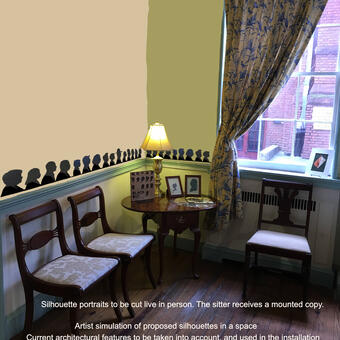
Lauren is currently expanding this traditional skill to create portraits towards cutting and/or exhibiting silhouettes in unexpected places. The silhouette experience Lauren is creating is more than the final product, more than the actual profile portrait. It is also the act of participation that allows time to slow, perceptions to widen. The tangible result is a memory-laden portrait that the visitor can take home, while the mirror image can become part of a public display of art.
Lauren enables visitors to connect the past, the present and the future by allowing for their immersion into a historical process, while at the same time experiencing the act of creation in the here and now, and by converting their likenesses into parts of an exhibit, enabling the visitor to be transformed into a future work of art.
However, silhouette-snipping is only one facet of the whole picture. Lauren combines presenting, educating, hospitality, spectacle, international relations, research, and the human spirit. She has developed a throughline connecting the past with the present, and usefulness with art, while allowing each to be accessible. The following portfolio spells out some elements, but is limited to only 10 projects and only 10 samples in each project.
Lauren built her business from scratch, while developing her own innovative style. Without a mentor, a teacher, or a preexisting framework that would have encompassed the many elements her business covers, she has forged the business from its inception to the current state, where she is drawing attention in an international arena. The elements of her personal style range from signage to timed tickets, media, clothing, historical vignettes, and last but not least bringing this historical artform to modern events.
ARTIST STATEMENT:
I cut silhouettes in order to create an out-of-time experience in which anyone can participate - people of every age, economic status, sex, or ethnicity. I make silhouettes to help people feel transported to a past era, connecting them to an experience that has happened for over 200 years: sitting for a silhouette portrait. Because the process of silhouette cutting is so fast - under two minutes - the experience doesn't take any precious time away from the rest of their day. Sometimes modern people might encounter me in modern places and would not initially think of the cutting process as a historical skill - and that's fine; let us all reconnect with the past without finding it stuffy or old-fashioned. We are not "back-in-the-day" (a cliche phrase) - we are together in the "here and now."
Some people are transformed by quietly experiencing the now: sitting for a real portrait, wondering how it is going to turn out, and taking a slow moment that is now turned into a lasting memory. Along with their experience sitting for their own portrait, they also receive the portrait to take home - appreciated for who they are, where they have been, and their real faces. They are "truly seen."
ABOUT SILHOUETTES:
Before photography, silhouettes were the way common people would have their portraits made. Baltimore has a long tradition with silhouettes, as they were cut at the Peale Museum starting in 1815. Silhouettes were called “the poor man’s portrait”; but in reality, the poor would have rarely had a silhouette made. We have few old portraits of people on the lower economic rungs of society’s ladder. Silhouettes continued to be created past the time when photography was invented; the public maintained their interest in silhouettes, be it as a novelty, out of nostalgia, or seeking a connection to a quieter, handmade, quaint portrait form. Silhouettes have often returned into society for over 150 years and are now popular again.
BACKGROUND:
Lauren grew up in Silver Spring, Maryland and received her B.F.A. from the Maryland Institute College of Art, in Baltimore, majoring in illustration. After 30 years as a (stage) performing artist in New Vaudeville, as a special events production manager, and professional facilitator, she started creating portraits in 2007 using the traditional silhouette cutting technique. Her work and philosophies have been published in numerous print and online publications relating to antiques and traditional craftsmanship, including Early American Life magazine, Flea Market Style magazine, Smithsonian Institution traditional artists video series, and her work is permanently on display at several immersive history museums across the USA. She has portraited the internationally famous and not-yet famous, and was even invited to the White House to cut silhouettes in 2018 but had to turn down the invitation.
Lauren Muney also educates and entertains the public about people who lived in the past, through time-immersive experiences generally known as living history. Living history museums, events, and environments let the visitors feel as if they are stepping into a time machine; to see, hear, and experience eras of time past. Her appearances are part interpretation, part education, part live artist demonstration.
For 42 years, Lauren has been involved in helping visitors and guests at museums, and events worldwide feel like they stepped back in time. In the past 15 years, she has worked directly with traditional museums and living history (immersive history) museums, and in 2018 was elected to the Board of Directors of the international organization "Association for Living History, Farm and Agricultural Museums" (ALHFAM). In ALHFAM, she is co-chair of an international initiative which preserves skills of the past and also skills of presenting living history (see her CV for more information). To date, she has volunteered almost 1600 hours for ALHFAM, and has helped tens of thousands of visitors to experience a high-quality adventure into the past.
Lauren also works in public and private settings at galas, fundraisers, schools, and other locations to provide this handmade, rapid portrait experience for traditional events - in an untraditional manner. More photos and information can be found on her website and social media such as Instagram and Facebook.
NEW WORK:
Lauren is currently expanding this traditional skill to create portraits towards cutting and/or exhibiting silhouettes in unexpected places. The silhouette experience Lauren is creating is more than the final product, more than the actual profile portrait. It is also the act of participation that allows time to slow, perceptions to widen. The tangible result is a memory-laden portrait that the visitor can take home, while the mirror image can become part of a public display of art.
Lauren enables visitors to connect the past, the present and the future by allowing for their immersion into a historical process, while at the same time experiencing the act of creation in the here and now, and by converting their likenesses into parts of an exhibit, enabling the visitor to be transformed into a future work of art.
- Public arts programs: artist residencies followed by exhibitions
- Creation of additional immersive spaces (historical vignettes)
- Guest artist programs
- Connecting old ideas from the past in interesting and interactive ways